

Interest rates around the globe have moved sharply higher over recent months, with no shortage of explanations. That no single reason works is not surprising, with most justifications seeming to lead to the observation that the shifts are rather rational:
Rising government debt and continued issuance may be increasing the risk of sovereign solvency crises
At least in the U.S., stable employment, resilient consumer spending and continued economic growth underpin the higher rate environment
Inflation is well off post-COVID highs but remains well above comfortable targets. Central banks will remain vigilant in their pursuit of price stability
The substantial financing needs associated with AI infrastructure may be increasing competition for capital
Rates are back to where they were prior to the Great Financial Crisis of 2008-09
We do not expect rates to move materially higher from here, but neither do we anticipate a broad decline absent a recession, clear signals of which have yet to appear in the data
Higher for Longer?
Across the developed world, yields on longer-term government-issued (“sovereign”) debt are meaningfully higher than at the start of 2026. Bond prices generally move in the opposite direction of yields, so the shifts higher have pressured bond returns. Enquiring minds want to know what those higher yields might be telling us about investor sentiment. The list of observations and explanations is long, but most can be summarized by the more obvious statement that the risks of owning government bonds are perceived to be higher now than they were at the beginning of the year. As generally must be the case for such a broad change in trend, investor thinking must have changed in dramatic ways over the past few months. That is, investors are digesting new information and/or rethinking prior perspectives. Pondering why and how investors have changed their minds can be useful, but it’s an exercise without the potential benefit of any manner of certainty.
Rising Global Sovereign Indebtedness
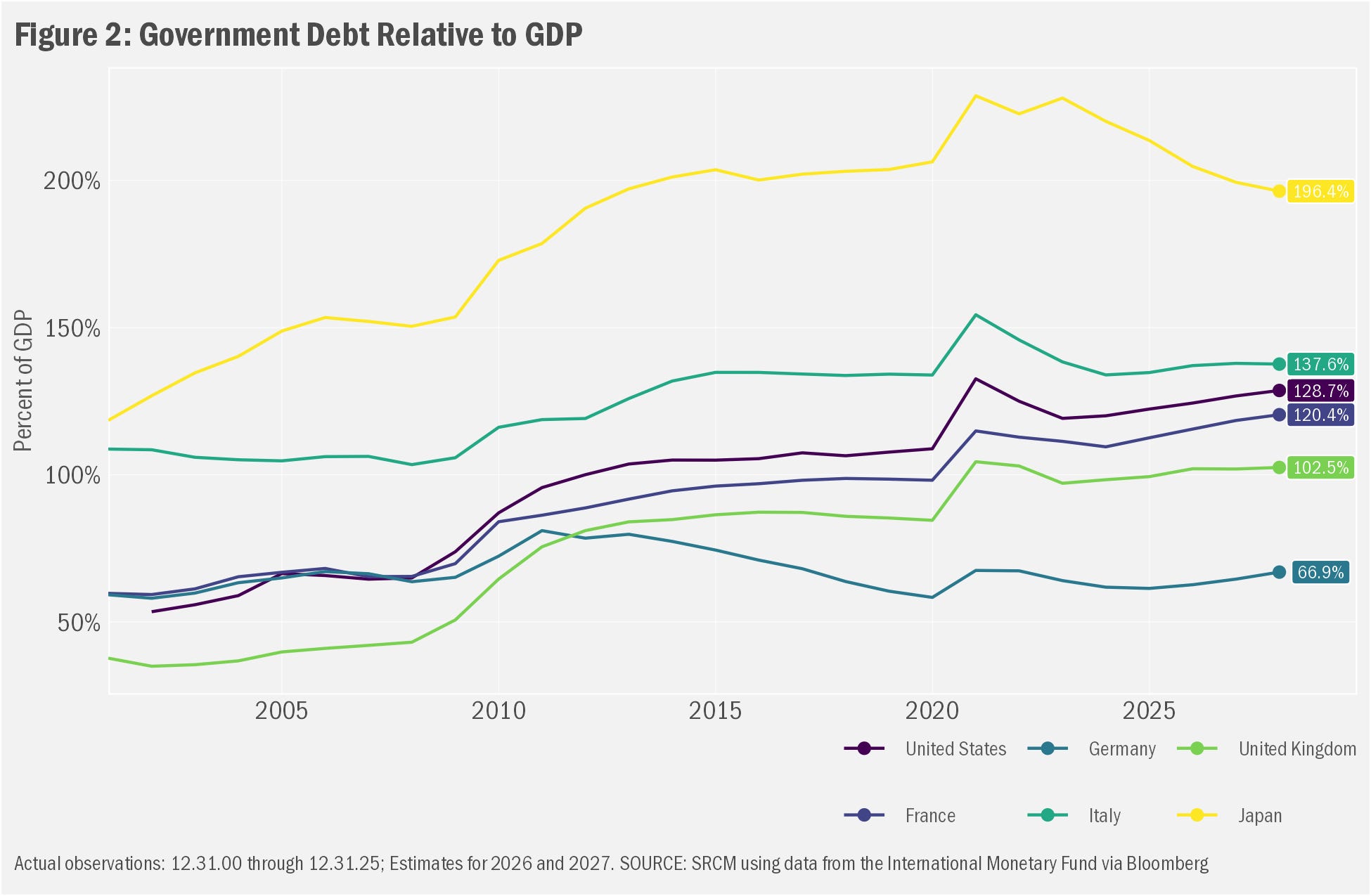
Among the stronger cases for higher rates is the fact that many developed countries have seen their debt burdens swell to increasingly uncomfortable levels (see Figure 2). Growing sovereign debt can be blamed on persistent budget deficits, which reflect total government spending in excess of tax revenue. Here in the States, deficits are among the highest they’ve been outside of times of war and macroeconomic crises. At nearly 6% of gross domestic product, that level is not widely expected to fall over the medium term. Meantime, though balance sheets can be qualified as generally healthy in the aggregate, corporate debt issuance has grown this year, with a notable dominance of generative AI-related capital raises having come to market.
Importantly, more debt supply does not automatically bring more investor demand. If investors are not looking to increase their fixed income exposures, new bonds may need to offer higher yields to compete with other investments that potential buyers believe offer more favorable expected returns. So, yields can rise even without investors selling the bonds they already own. With additional issuance coming to market, insufficient new demand to absorb that supply may be enough to push rates higher and bond prices lower.
Another self-reinforcing trend is the fact that, as rates rise and older debt matures, new debt must be issued at those higher rates. So, even if governments or companies are merely refinancing older debt, they may be doing so at a higher cost. For many governments, both the level of debt and the cost of that debt are rising. When those trends might become unsustainable remains open for debate, but the increasing potential of a developed-market sovereign debt “event” (we’re looking at you, France) likely has pulled rates higher.
Higher, Not High
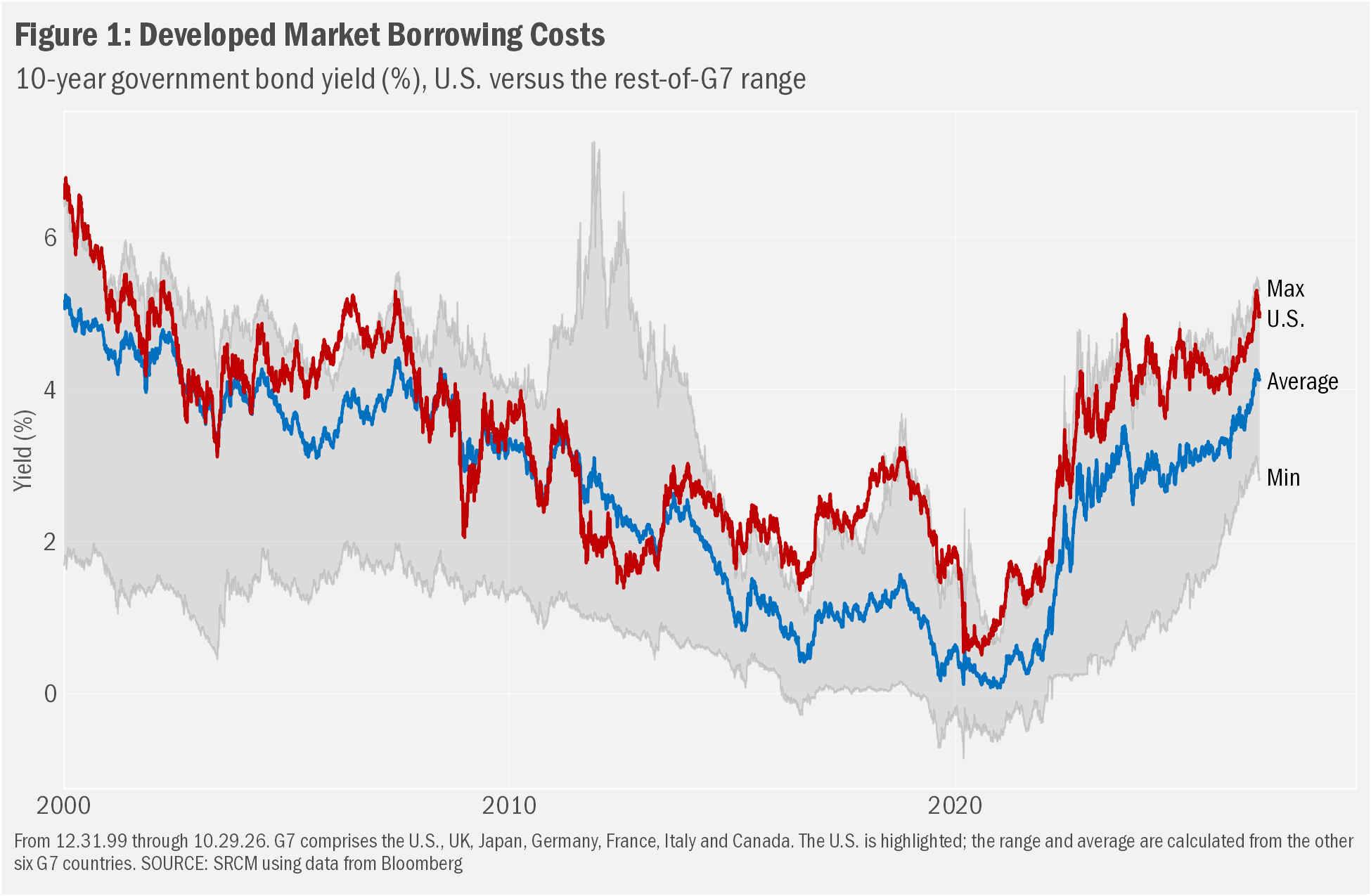
While of little explanatory use for the rest of the developed world, another reasonable take on the why of higher rates is the fact of strong domestic growth. U.S. GDP growth has remained resilient despite higher rates, suggesting that they have not proved a hindrance to macroeconomic activity. While growth has been bolstered by investment in artificial intelligence infrastructure, consumer spending also has remained relatively robust, supported by higher wages, tax cuts and greater household wealth in the aggregate. Given that strong growth backdrop, and in the context of bond market history (see Figure 1), current yields are not altogether high, even as they are higher than they have been for some time.
Prices Matter
Another possible explanation for higher bond yields is that investors want more compensation for inflation. Robust growth, alongside already high and potentially worsening inflation trends, could lead them to expect inflation to remain uncomfortably high or to rise further. A regularly cited data series offers limited support for that explanation. Figure 3 shows the difference between yields on 10-year Treasury bonds and 10-year Treasury Inflation-Protected Securities (TIPS). That comparison can be used to gauge inflation expectations over the next 10 years. The difference between the two yields can be read as the rate of inflation at which a potential buyer of a Treasury bond is indifferent to the choice between one with and one without inflation protection. That difference has barely budged of late, suggesting that this measure of long-term inflation expectations, at least, has not increased. But the comparison is imperfect: the TIPS market is dramatically smaller than the non-TIPS Treasury market ($1.77 trillion versus $34.4 trillion, according to Bloomberg), which might have a way of skewing the results (e.g., the size disparity suggests the opinions of many would-be, but non-buyers of Treasuries are not being expressed by the yield gap; many would-be buyers have more direct/efficient means of expressing views regarding inflation). Shorter-term inflation expectations, as reflected (again, perhaps imperfectly) in the 1-year breakeven rate, have run higher, though. So, while these data do not rule out inflation concerns, neither do they clearly establish them as the driver of higher yields.
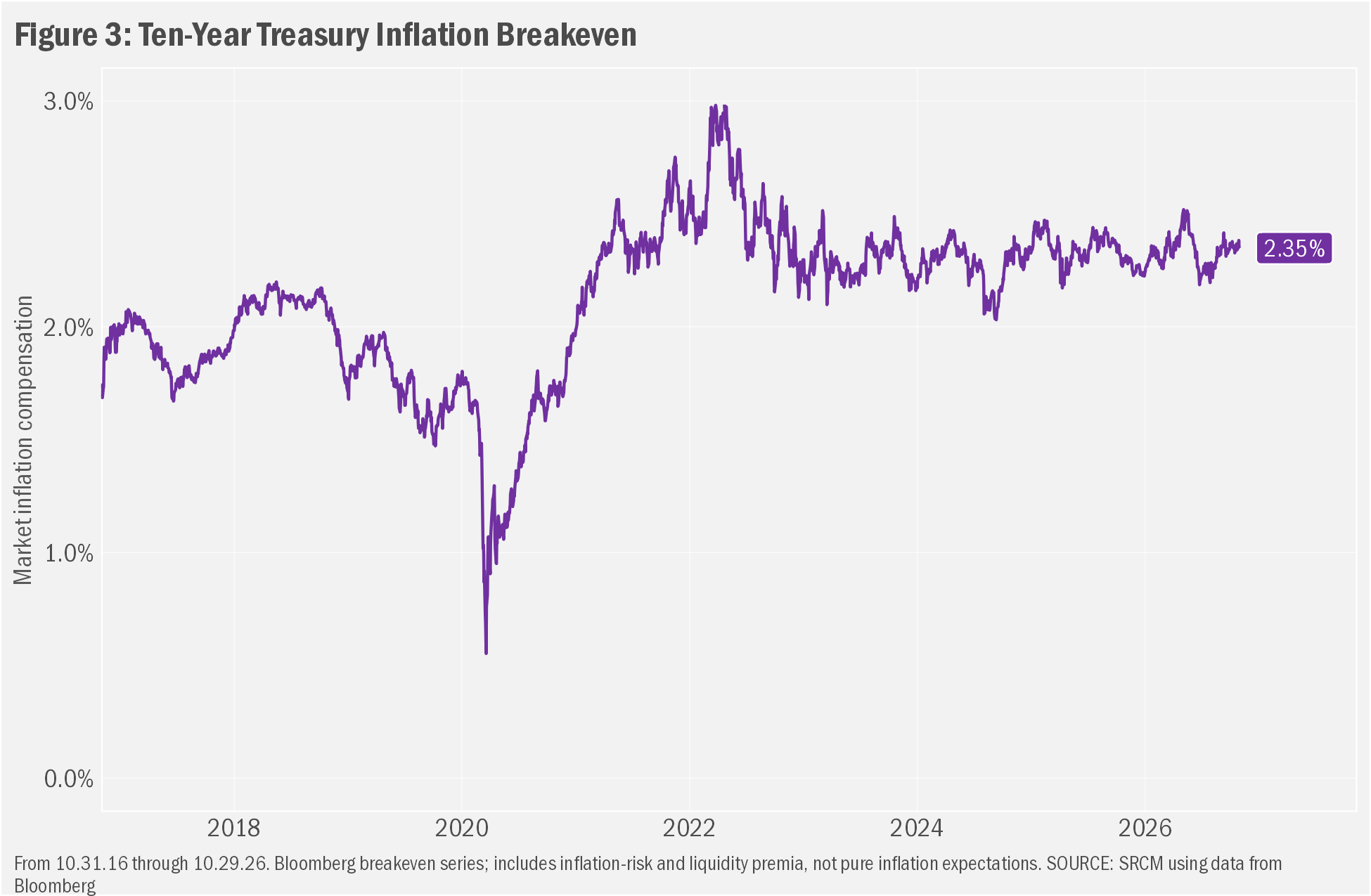
Even so, it may be that inflation remains a broader, perhaps not-so-obvious concern. As one argument against the TIPS take suggests, some investors who expect inflation to be higher for longer might at the same time expect the Federal Reserve to remain vigilant to that risk and maintain higher rates for longer in order to counteract upward pressures on prices. That expectation might be expressed further out the nominal Treasury curve (investors still pause purchases until the price/yield is right). One arrives at higher longer-term rates, but without the corresponding uptick in inflation expectations.
Wobbly Fed
Interestingly, that the Fed held steady on its rate target this month may run against that narrative. Lots of scratching-head commentary wondering why, given the employment/growth/inflation backdrop. Indeed, the latest wholesale inflation readings have been moving in the wrong direction, with elevated energy costs arguably beginning to flow through to downstream prices. At the same time, though, many will argue that there’s not much the Fed can do to influence energy (and food) prices, which is why they prefer an inflation gauge that excludes both buckets of goods. Even so, prices at the pump and in the grocery store are among those most closely watched...and deeply felt...by U.S. consumers, so we expect concerns that the Fed isn’t doing enough on the inflation front (by continuing to raise rates) to remain in the headlines, even as the current administration reiterates its narrative that rates should be much lower than they are now. Uncertainty regarding future Federal Reserve rate decisions, then, also may be adding to the risks of further-out bonds.
May be true that the Fed needs to do more on the inflation front. But we’d argue (along with many others), too, that the broadly still-higher term structure of interest rates in the U.S. is doing a fair bit of work for the Fed already. That is, it’s quite difficult for the Fed to directly influence longer-term rates (Chairman Alan Greenspan spoke to this “conundrum” in his February 2005 testimony to Congress), which will have actual influence on the economy, by changing its target for the rate at which banks lend to each other overnight, which theoretically has little direct impact on the broader economy. Some may ask, then, why the Fed takes this approach. The methodology rests on the idea that longer-term rates can be seen as a sequence of short-term rates plus a premium for uncertainty. For example, the current 10-year yield can be viewed as reflecting a sequence of ten future 1-year rates plus some amount of additional compensation to help make the longer-term commitment attractive. Higher long-term yields may therefore reflect both a bias toward higher future rates and greater uncertainty about their paths.
If actions that the Fed takes at the front end are broadly expected to be durable, then those shifts may “transmit” out to longer durations. But the deeper the look into the future, the greater the weight that other factors may have in investor math, so the indirect transmission mechanisms may prove weaker.
Who Knows Why, But Here We are
In sum, myriad explanations may account for higher rates this year. We’ve highlighted just a few on these pages. No single explanation gives us certainty about what comes next. We’d argue, though, that there is little reason for rates to be broadly lower than they are at present. Current rates are not high by bond market standards, nor do they yet appear to be weighing heavily on macroeconomic activity, the backdrop of which can be seen as justifying the rate environment. But this return to rates of yore is still relatively new, and potentially necessary fiscal adjustments may not yet have taken place. With the era of cheap debt ( “free money”) now well in the past, rising interest burdens will force corporations and governments alike to reckon with higher financing costs.
We have the sense (because such is normally the case) that bond markets might digest a modest increase in business distress without too much drama. Some manner of recessionary turn, not seemingly in the data at present but always lurking, could cause a more dramatic widening in spreads, however. A sovereign debt crisis could have wider, more dire implications. France is at the top of relevance for this thread, with any potential dislocation and contagion effects in Europe and abroad certainly among the greater risks to bond markets and even investment markets in general.
Portfolio Context
Our fixed income approach starts with two relationships: bond prices generally move opposite to interest rates, and sensitivity to rate changes generally increases with time to maturity. Duration is the measure we use to describe that sensitivity. When the yield curve is “normal,” rates are higher the longer the time to maturity (the curve is upward sloping). In such times, higher expected returns in the form of higher yields come with higher expected volatility; the additional income is not a risk-free benefit. While we generally favor the shorter end of the yield curve for its lower sensitivity to interest-rate changes, we retain flexibility in two ways. The funds we select generally can change the average maturity of their holdings in an effort to capitalize on changes in rates. We also seek to adjust potential portfolio-level duration exposure through the choice and mix of funds, responding to what we see as potential secular, or long-term, shifts in rates. These choices are intended to balance income and rate sensitivity while remaining true to our mantra: the future is truly unknowable.
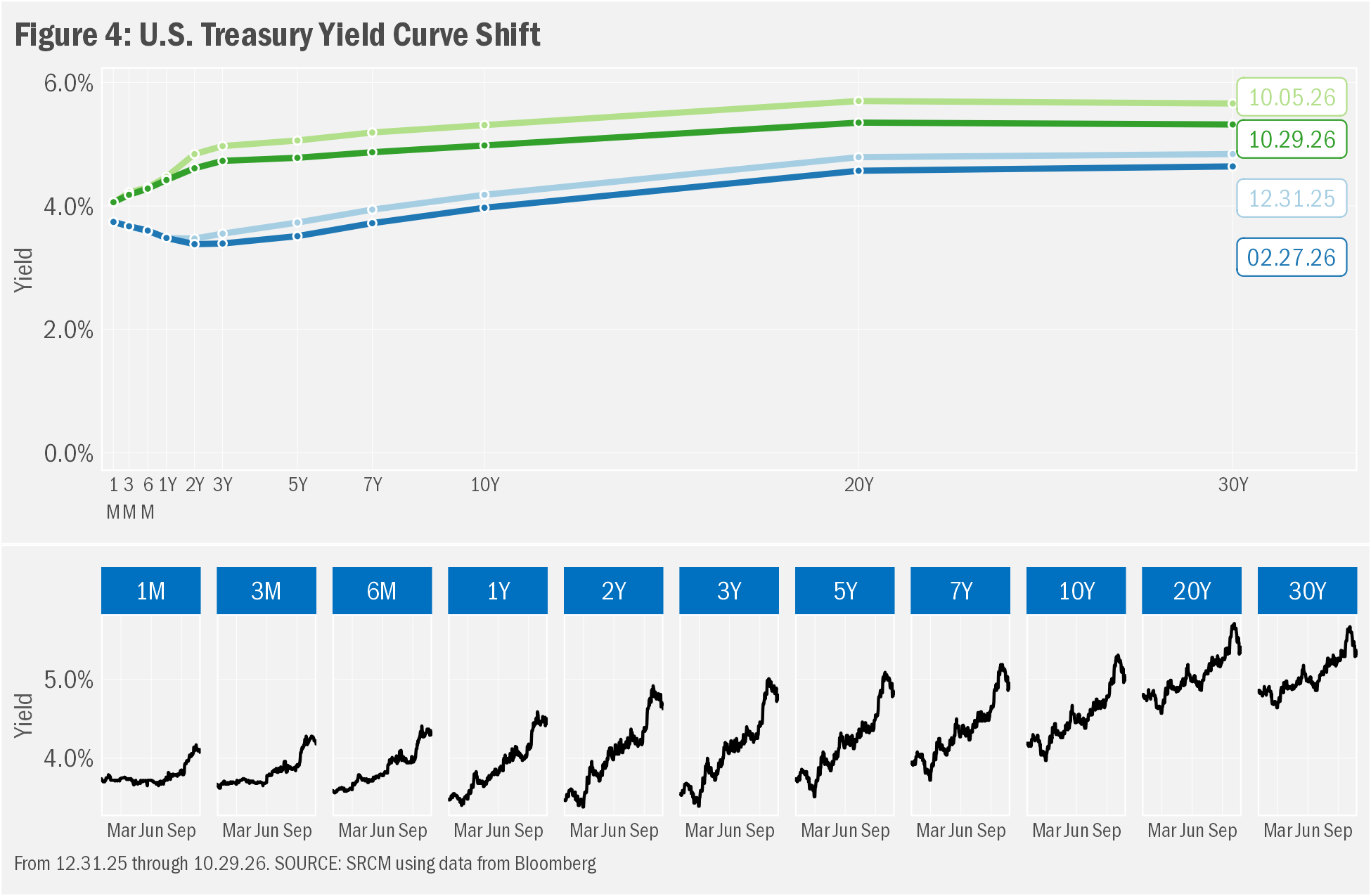
Rising rates are generally bad for bonds, and rates are higher on the year across the board (see Figure 4). The price impacts from that shift upward in rates generally will be greater for longer maturities, because sensitivity to interest-rate changes typically increases with the time remaining until repayment. As we penned this note, longer-term rates are near the middle of their 3-month average, while front-end rates are pinned near the top of that trailing-quarter range. For investors positioned generally at the shorter end of the curve, the initial price effect may have persisted, although the additional income by now may have offset some or even all of that decline. Investors with positions further out the curve may have experienced a wider range of outcomes, though even here the combination of the round-trip in rates since the end of June along with the higher income may have brought some relief from the more severe drawdown in September.
Important Information
Signature Resources Capital Management, LLC (SRCM) is a registered investment adviser. Registration does not imply a certain level of skill or training. This material is provided for informational purposes only and should not be construed as investment advice or as an offer to buy or sell any security or implement any investment strategy. A decision to engage SRCM should be made only after carefully reviewing the applicable investment management agreement and SRCM’s Form ADV Part 2A and Part 2B, conducting any due diligence you consider appropriate, and consulting your legal, tax, and accounting advisors. All investing involves risk, including the possible loss of principal. Additional information regarding SRCM’s services, fees, risks, and conflicts of interest is available in the applicable investment management agreement and Form ADV. Information presented here is unaudited, subject to change, and intended only as a general guide to current views.
Past performance is not a guarantee of future results. The views expressed reflect SRCM’s opinions as of the date of writing, are subject to change, and may not reflect current thinking. This material is based on proprietary research and analysis, together with information believed to be reliable; however, SRCM does not represent that such information is accurate or complete and accepts no liability for any loss arising from its use. Certain content may be theoretical in nature and subject to inherent limitations. Any references to market exposures or specific investments are provided for illustrative purposes only and may or may not be reflected in client portfolios. No reader should assume that any investment or strategy discussed was or will be profitable. This material may also contain projections, targets, or other forward-looking statements based on current expectations and assumptions. These statements are not guarantees of future outcomes, and actual results may differ materially. You should consult your financial advisor to determine whether any investment or strategy is appropriate for your individual circumstances.