

Global stock markets tanked on 11.05, the drop presumably sparked by fears that the “blue wave” U.S. electoral result will spoil the AI vibe. Thing is, seems this initial AI wave already had crested sometime earlier upon third-quarter earnings from a few AI leaders that showed AI to be mostly self-impoverishing at present. Since there’s still little evidence of commensurate profit from the tech, some manners of rationalization may be setting in throughout the investment space. At least for the moment. We’re pretty confident, though, that the AI investment theme is far from exhausted, believing:
Investments in data centers, the underlying technologies and supporting architecture will continue apace, if not at rates projected even a month ago
Investors on balance seem still well confident in the long-term prospects for AI tech, though we’d expect some manner of greater caution among investors of all sorts as potential profitability sees stronger emphasis
Legislation is more likely to seek to balance AI positives and negatives than prove a widely destructive force
The “where and how much” of spending along with the “when” of profits will remain top-of-mind
Markets will remain volatile against changes in policies, perceptions and plans
Fearing the Spend
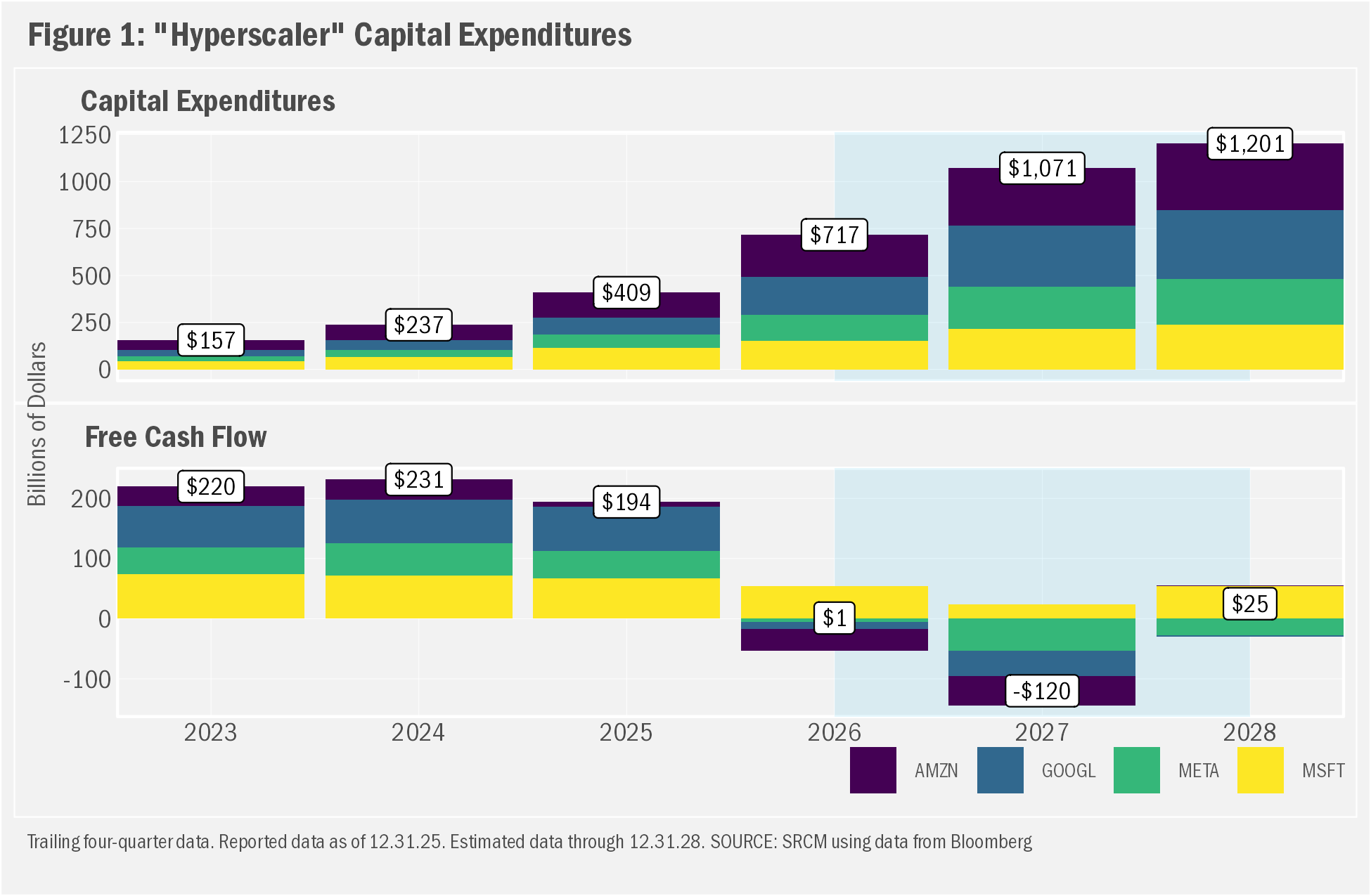
The S&P 500 Index dropped 4.35% on November 5, two days after U.S. elections resulted in one of the nation’s more dramatic turnabouts in political party representation. Day-after markets were rather ebullient, perhaps expressing relief that the campaigns were finally over. By Thursday, though, investors seemed to have begun pricing in the unknowns of potentially more onerous oversight and regulation, with artificial intelligence topping the list of potential targets. Opposition to AI from many sources and in various forms has been growing, such that concerns regarding the tech became a dominant thread in the discussions leading up to the vote. The most prevalent theme, we found, was growing hostility toward the data centers powering AI. But challenges to the unprecedented infrastructure build extend beyond the political; even before the election, a few of the AI “hyperscalers” (so deemed for their aggressive expansion in AI-related compute capacity and capabilities) provided calendar third-quarter earnings updates that failed to suggest there would be any relief forthcoming on the capital expenditure front (see Figure 1), even as they offered little indication their massive investments were on track to provide commensurate return in the form of actual profit.
Tempering the Tantrum
But before we get too far ahead of ourselves, let’s not yet make too much of the election and the subsequent market move. Big as the Democrat wave was, seems moderates comprised its breadth. To the extent that assessment proves true, there’s reason to believe that regulatory traction might be more likely found, if anywhere, in the middle ground between onward-and-upward and cease-and-desist. Our expectations, then, are for a slowing in rather than a conclusion of progress on the AI front. And probably (at least not yet) a rather limited downshift in tempo at that.
Importantly, we think the increasing multi-front pressures will begin to force a more rational approach to the AI infrastructure build. Investors may react more positively to retrenchment (even if it proves modest) in hyperscaler capex. So, too, might politicians and the populace. Even so, relief for hyperscaler investors could mean pain for AI-computing component suppliers, especially chipmakers. No surprise that group was among the worst performers in the latest drawdown, having variously proved laggards for some bit of time even before 11.05.
As investors continue to alter expectations as they digest the potential evolutions of and interactions between domestic politics and artificial intelligence, we imagine global stock markets may remain turbulent for some time. But as hinted by the juxtaposition of the hyperscalers and the chipmakers, there’s reason to believe, as we already have been noticing this in recent market activity, that we might find investors less quick to sell stocks in companies not altogether enmeshed in the AI space. Non-AI-adjacent names might even find investor interest perking up over time to the extent that the still mostly presumed benefits of the incorporation of AI into everyday work processes foster actual growth in productivity.
And for Broader Context
Zooming out, as we show in Figures 2 and 3, drawdowns are a rather regular feature of the stock market, the U.S. already having seen one earlier this year of more than 9%. This latest decline now rests at just under 6%. Even with Thursday’s drop, though, the S&P 500 Index is up 8.4% for 2026, below the market’s longer-term annual average total return of 11.7% since 1949, but not too far off.
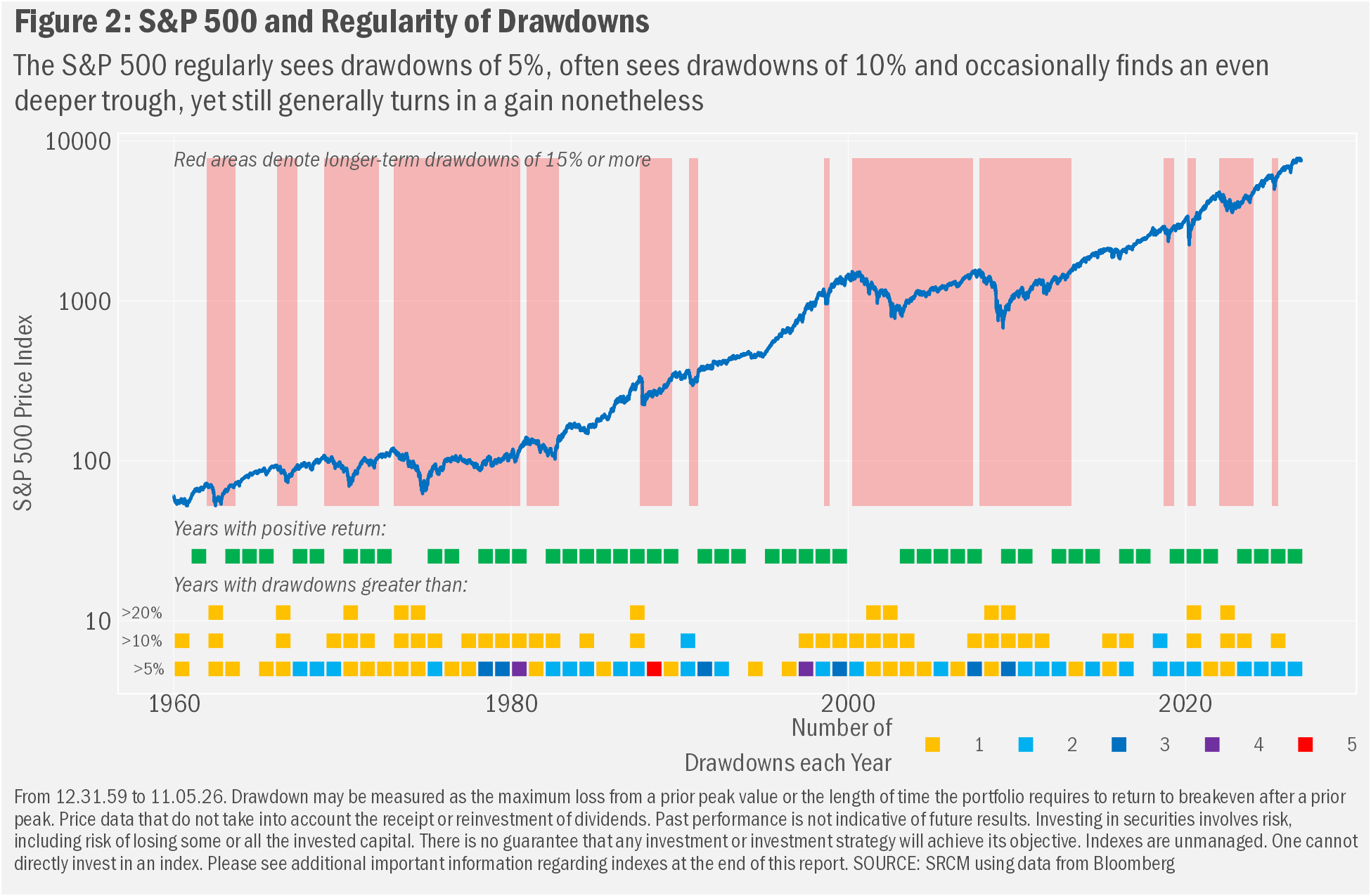
Investors may need time to calm to the idea that the primary theme to which the broad-market gains of the recent past have been ascribed might have more limited going-forward strength. Or that statement could be completely off base: maybe the AI theme has investment potential we have yet to even imagine. We’d place a lesser weight on the latter, but the risk of any such assessment is, as always is the case, we have no idea what the future holds. Market volatility is the expression of that uncertainty.
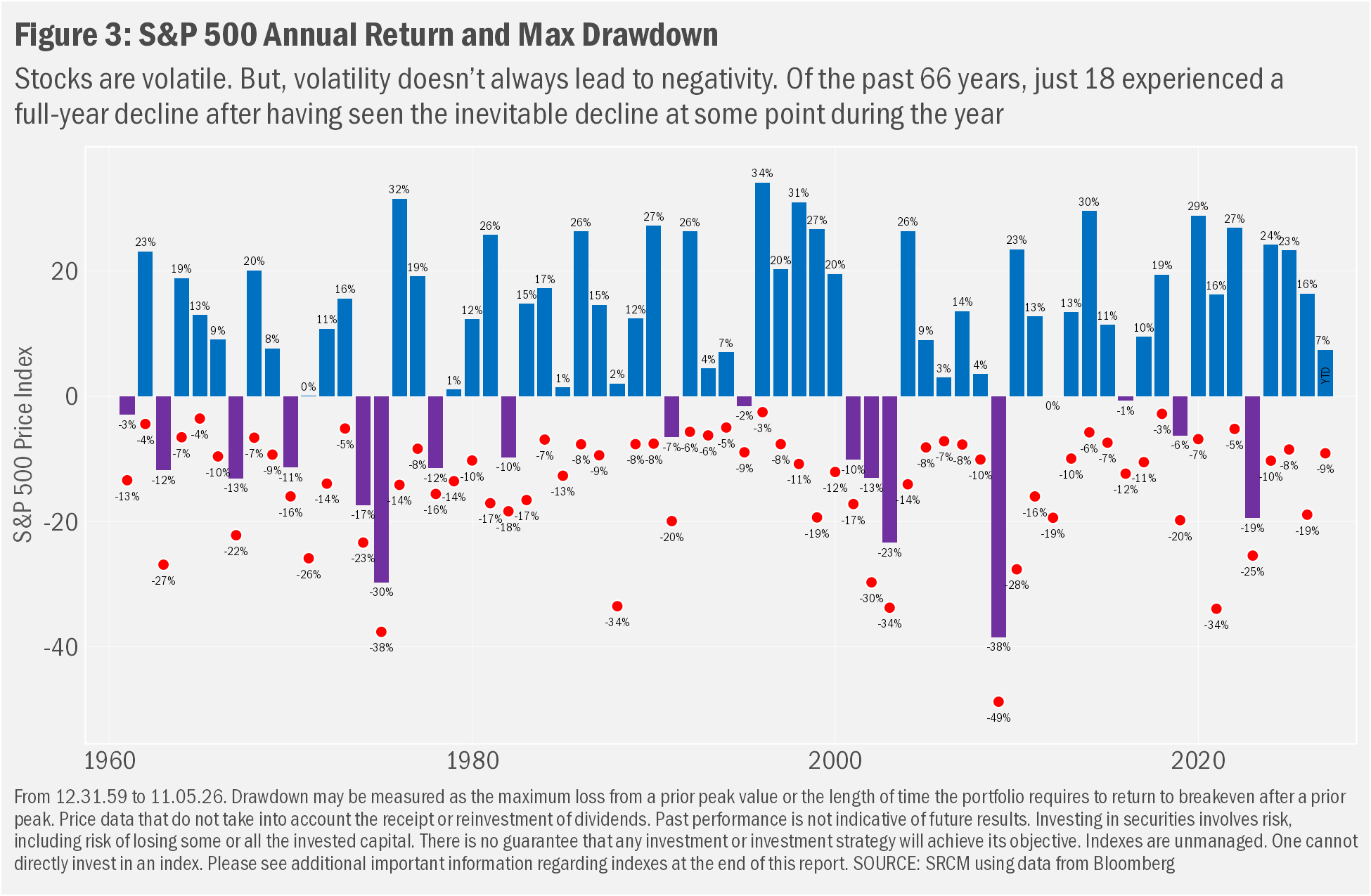
Recognizing that the market is forever exposed to risks we can define (e.g., the ongoing wars in Ukraine and Iran) and those we cannot (e.g., ???), we don’t think there’s reason for broader panic. While we may be right to be concerned that a presumed market prop has been weakened, such changes in sentiment are not rare and yet the stock market has powered beyond every such past drawdown barring the present one.
As always, happy to discuss further. Please reach out to an advisor with any questions and concerns you may have.
Important Information
Statera Asset Management is a dba of Signature Resources Capital Management, LLC (SRCM). SRCM is a registered investment adviser. Registration does not imply a certain level of skill or training. This material is provided for informational purposes only and should not be construed as investment advice or as an offer to buy or sell any security or implement any investment strategy. A decision to engage SRCM should be made only after carefully reviewing the applicable investment management agreement and SRCM’s Form ADV Part 2A and Part 2B, conducting any due diligence you consider appropriate, and consulting your legal, tax, and accounting advisors. All investing involves risk, including the possible loss of principal. Additional information regarding SRCM’s services, fees, risks, and conflicts of interest is available in the applicable investment management agreement and Form ADV. Information presented here is unaudited, subject to change, and intended only as a general guide to current views.
The S&P 500 Index measures the performance of the large-cap segment of the U.S. equity market.
Past performance is not a guarantee of future results. The views expressed reflect SRCM’s opinions as of the date of writing, are subject to change, and may not reflect current thinking. This material is based on proprietary research and analysis, together with information believed to be reliable; however, SRCM does not represent that such information is accurate or complete and accepts no liability for any loss arising from its use. Certain content may be theoretical in nature and subject to inherent limitations. Any references to market exposures or specific investments are provided for illustrative purposes only and may or may not be reflected in client portfolios. No reader should assume that any investment or strategy discussed was or will be profitable. This material may also contain projections, targets, or other forward-looking statements based on current expectations and assumptions. These statements are not guarantees of future outcomes, and actual results may differ materially. You should consult your financial advisor to determine whether any investment or strategy is appropriate for your individual circumstances.