Waiting on IPO
We don’t see much reason to make an investment decision about Anthropic immediately before or after it first becomes publicly traded.

Anthropic (ANT) priced its IPO this evening and will begin trading tomorrow, capping what seems like a lifetime of hype and expectation. Artificial intelligence has attracted unprecedented investment, Anthropic is one of the best-known companies in the space, and an IPO would give public-market investors their first opportunity to buy its shares.
Perhaps surprisingly (annoyingly?), we won’t share a view on whether Anthropic’s stock will prove to be a good investment. We do think it might not be the best idea to buy Anthropic shares shortly after they begin trading. Same subject, different questions.
By suggesting potential investors wait it out, we aren’t stating that Anthropic is overvalued, that its business will disappoint, or that its shares are likely to fall after they begin trading. We simply don’t see much reason to make an investment decision about Anthropic immediately before or after it first becomes publicly traded.
Characteristically Weak
History gives us some reason to be patient. Dimensional Fund Advisors studied[1] 6,362 U.S. IPOs from 1991 through 2018, looking to gauge shorter-term relative performance of IPOs. Beginning in 1992, the investment manager tracked a market-cap-weighted portfolio of stocks that had gone public during the previous 12 months, rebalancing it monthly. While past performance is not indicative of future performance, the historical results are telling. The portfolio returned 6.93% annually over the 27-year period and substantially trailed the broad U.S. stock market benchmarks used by Dimensional in the study.
Dimensional did not conclude from their research that companies perform poorly simply because they recently went public. Rather, they found that IPOs as a group tended to resemble small-growth, low-profitability, high-investment stocks, characteristics associated with lower expected returns.
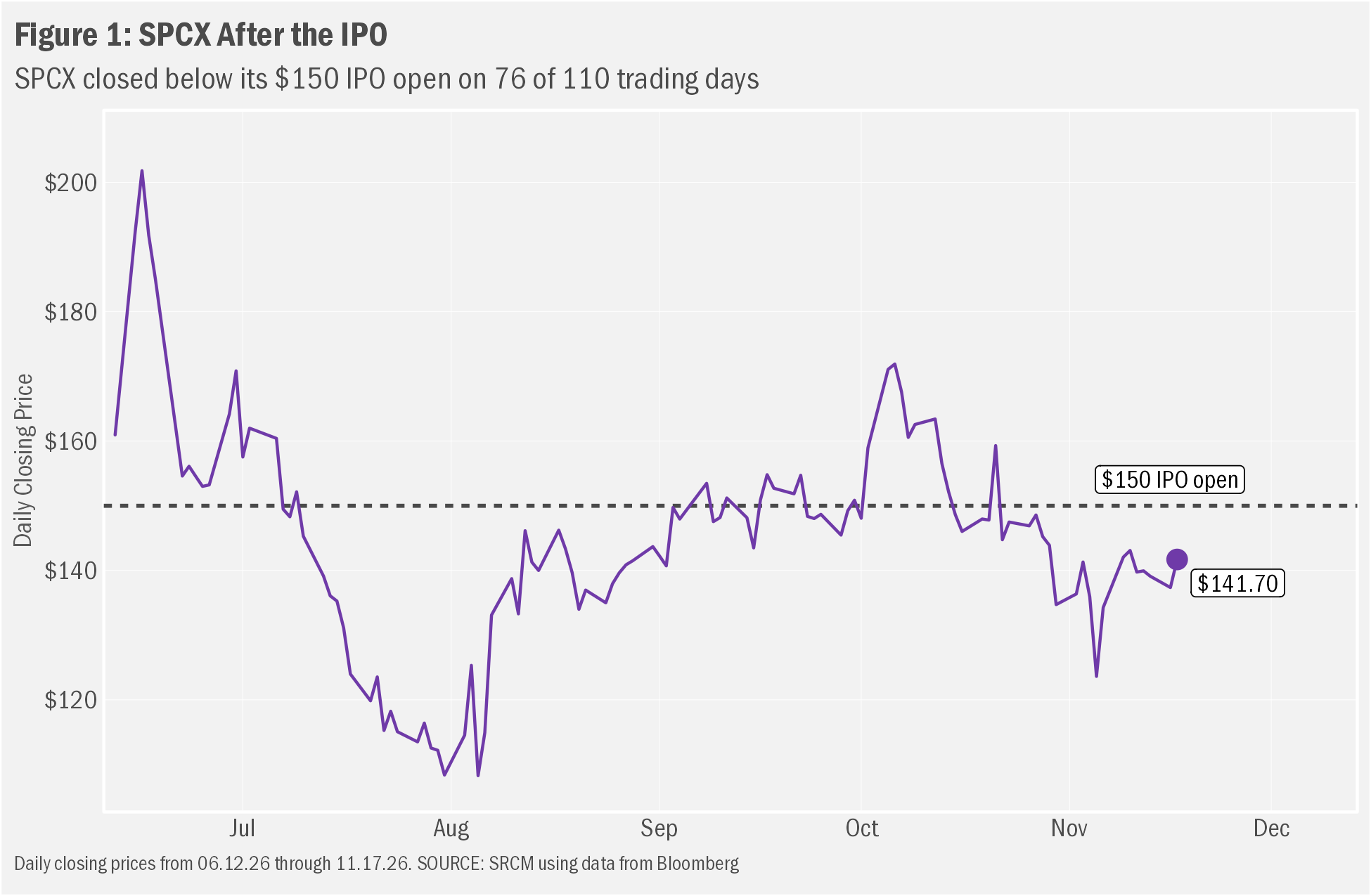
Don’t need to look too far for supporting evidence. The other highlight IPO of 2026, SpaceX (SPCX), a rocket company, turned broadband communications provider turned space-based AI company (and potentially soon to become a rocket- and car- and rocket car-producing, taxi-service providing, space-based AI, moon- and Mars-shot company with humanoid robotics, battery storage and tunnel-digging side gigs), entered the public markets on June 11, pricing the shares at $135 each, thereby raising close to $86 billion (after all was said and done). The shares opened at $150 the next day and since have traded as high as $225.64 and as low as $104.83. It has been a volatile ride, during which the stock more often than not has traded below the range established in the immediate aftermath of the IPO.
Why the Hurry?
Sure, SpaceX is just one example. And Anthropic might see its shares chart an entirely different path following its IPO tomorrow. Based on the broader evidence of the Dimensional study and others, we’d rather not seek to resolve whether to buy into a stock at or immediately after its IPO by predicting what the stock will do next.
Of course, waiting won’t always prove the right decision in hindsight. The initial offering may turn out to have been the cheapest opportunity a public-market investor ever gets to buy the shares. So be it. We don’t believe successful investing requires capturing every gain available in the market. Trying to do so would require us to know far more about the future than we ever will. And that problem isn’t unique to IPOs. Consider how confidently investors can describe the companies that dominate the market today. We know their products. We know their leaders. We can study their financial statements and competitors. There are analysts whose full-time jobs are to understand them. What we don’t know is what the world around those companies will look like five, ten or twenty years from now. And that tends to matter quite a bit for the returns their stocks ultimately produce.
Stories Evolve
There is ample reason to be excited about Anthropic’s business. The company is a driving force behind a technological change that may prove to be of generational importance. And it will be the first truly “pure play” AI stock to be available to investors. But sensing a compelling story about a company or imagining what seems like an attractive future for the company is not the same thing as knowing how its shares might perform over time.
History is full of businesses that once appeared to have extraordinary futures and eventually fulfilled those expectations and more. It is also full of businesses whose futures looked extraordinary until competition, technology, regulation, financing, management decisions, or something nobody had thought much about changed the story. And there is another category that is easy to forget: companies that became enormously successful even though few investors were talking about them beforehand. That is part of the reason we diversify. We don’t expect to identify all of tomorrow’s winners today.
Secondly, a compelling story does not necessarily make for an attractive stock. That is, if everyone already senses the future looks bright for a particular company, then the stock likely already will reflect that future. The future realized, therefore, likely will need to be even better than had been imagined for the stock to prove a relative bargain in hindsight.
Dimensional has looked at this question from another direction[2]. In a separate study of individual U.S. stocks covering rolling periods from 1927 through 2020, it found that fewer than half of stocks survived for 20 years, and only a little more than one in five both survived and outperformed the broader U.S. market. Perhaps more interestingly, knowing which stocks had previously been winners didn’t provide much help identifying the next ones. Stocks that had outperformed over the previous 20 years were about as likely as previous underperformers to survive and outperform during the following decade: roughly 30% in either case. That doesn’t mean research is useless or that businesses don’t matter. It means the connection between a story we can understand today and an investment result years from now is considerably weaker than it may seem.
The Future Gets a Vote
And so, we seek to diversify our portfolios in part because it removes the obviously impossible-to-meet requirement to identify the handful of companies that will produce extraordinary results. A diversified investor doesn’t need to know whether the most important company of 2045 will be Anthropic, another company that already exists, or a company that hasn’t even been founded yet. Instead, an investor can own thousands of companies and allow the winners to reveal themselves in the fullness of time.
That approach guarantees nothing. It means owning companies that disappoint, even fail. It also means potentially owning successful companies without having recognized earlier that they might be successful. Think about the predictions investors might reasonably have made twenty years ago about technology, energy, financial markets, geopolitics, interest rates or the largest companies in the world today. Some would have been right. Many would have been wrong. And some of the things that ended up mattering enormously would hardly have appeared in the predictions at all. We have no reason to think the next twenty years will prove any different.
P.S. on Anthropic
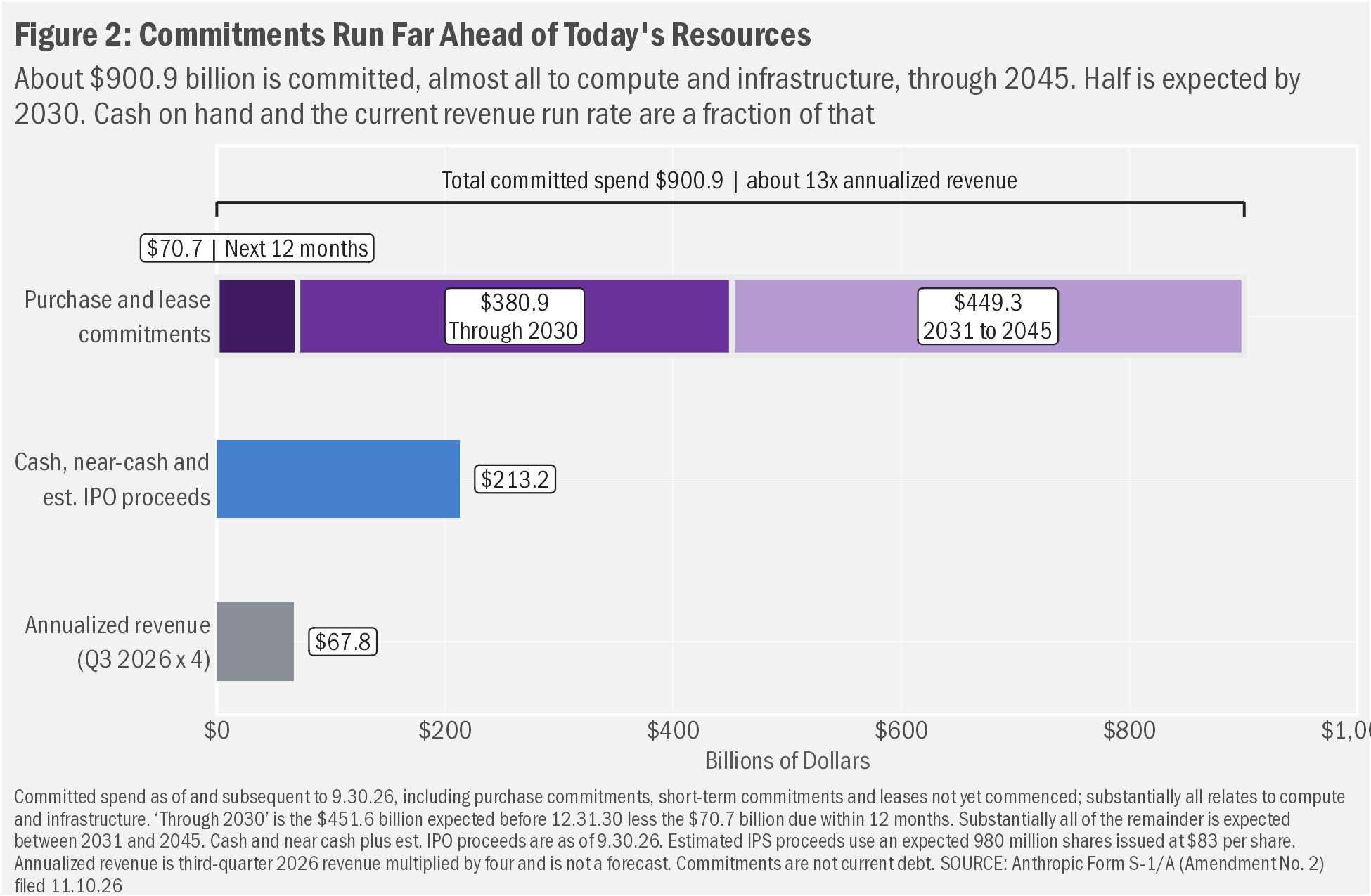
Well, of course we have observations re: risks to the Anthropic story. Our take summarized in four bullets and one chart:
1) Anthropic is an extraordinary company, with only one true peer, and a presently lagging one at that.
2) But, in our opinion, the expected valuation at the time of the IPO already reflects outstanding prospects.
3) Meantime, the range of potential outcomes for Anthropic is wide, in our view predominantly defined by 1) its ability to bridge the chasm between costs to provide AI services and the revenue those services provide, and 2) the evolution of the competitive and regulatory landscapes.
4) Regarding the competitive landscape, Anthropic remains at a sizeable disadvantage from a cash flow standpoint. Anthropic has no equivalent of Microsoft’s Office 365/Azure combination, Meta’s or Alphabet’s advertising businesses, or Amazon’s marketplace/cloud infrastructure to help fund its buildout. And as we move further into the future, access to resources to fund the ongoing infrastructure build likely will prove a strong differentiator in terms of relative success. With nearly a trillion dollars in future infrastructure commitments forthcoming, Anthropic may need to raise funds from new equity issuance (dilutive to existing shareholders) and/or debt (potentially increasing the fragility of the model). And with seemingly everyone in the AI realm raising money all at once for the foreseeable future, equity and debt investors alike are likely to become increasingly choosy when deciding where/when to allocate their assets, with higher expected returns (read: higher expected costs to the fund raisers) a potential consequence.
[1] From Dimensional Fund Advisor’s website: Using data from Bloomberg, “Dimensional evaluated IPO returns by forming a hypothetical market cap-weighted portfolio consisting of IPOs issued over the preceding 12-month period, rebalanced monthly. The sample includes US market IPOs, including US-domiciled companies and foreign-domiciled IPOs in the US, with an offering date between January 1, 1991, to December 31, 2018. Excluded from the sample are IPOs with an offer price below $5, unit IPOs (common stock and warrants), and IPOs involving real estate investment trusts, closed-end funds, American depository receipts, partnerships, and acquisition companies. The hypothetical IPO portfolio is formed December 31, 1991, and is rebalanced monthly to include all firms with an IPO during the prior 12-month period. Weights are based on prior month-end market capitalization. Indices are not available for direct investment; therefore, their performance does not reflect the expenses associated with the management of an actual portfolio.” https://www.dimensional.com/us-en/insights/ipos-profiles-are-high-what-about-returns
[2] https://www.dimensional.com/us-en/insights/singled-out-historical-performance-of-individual-stocks
Important Information
Statera Asset Management is a dba of Signature Resources Capital Management, LLC (SRCM). SRCM is a registered investment adviser. Registration does not imply a certain level of skill or training. This material is provided for informational purposes only and should not be construed as investment advice or as an offer to buy or sell any security or implement any investment strategy. A decision to engage SRCM should be made only after carefully reviewing the applicable investment management agreement and SRCM’s Form ADV Part 2A and Part 2B, conducting any due diligence you consider appropriate, and consulting your legal, tax, and accounting advisors. All investing involves risk, including the possible loss of principal. Additional information regarding SRCM’s services, fees, risks, and conflicts of interest is available in the applicable investment management agreement and Form ADV. Information presented here is unaudited, subject to change, and intended only as a general guide to current views.
Past performance is not a guarantee of future results. The views expressed reflect SRCM’s opinions as of the date of writing, are subject to change, and may not reflect current thinking. This material is based on proprietary research and analysis, together with information believed to be reliable; however, SRCM does not represent that such information is accurate or complete and accepts no liability for any loss arising from its use. Certain content may be theoretical in nature and subject to inherent limitations. Any references to market exposures or specific investments are provided for illustrative purposes only and may or may not be reflected in client portfolios. No reader should assume that any investment or strategy discussed was or will be profitable. This material may also contain projections, targets, or other forward-looking statements based on current expectations and assumptions. These statements are not guarantees of future outcomes, and actual results may differ materially. You should consult your financial advisor to determine whether any investment or strategy is appropriate for your individual circumstances.
 | A guest post by
|